Friday, 5 September 2014

The Big 5

Yes, it is a tourist gimmick. However, it is also somewhat similar to the old days when some of us would collect football cards or plastic toys from the cereal packets - you just have to get them all.

In Africa, the "Big 5" refer to the elephant, buffalo, lion, leopard and rhino. I don't really see the significance of these five; they are not the strongest or tallest. Why is there no giraffe, zebra, ostrich or wilderbeest?

On both of our trips we managed to photograph four of the five. Des and I were lucky enough to complete the set.

So this collection of photographs is for Andrew and Sue, who accompanied us on our first trip to Masai Mara, and Dave and Kath, who were with us on our second.


Rhino - We were very lucky to see this pair, seeing as it was during the middle of the day. Our guide was very excited. Rhino are perhaps the shyest animal in game reserves. They are also the most desirable for poaching as their horn is still prized in East Asia.
This one is for you Dave and Kath - sorry you didn't get to see any (except for a tiny black speck over a kilometre away).


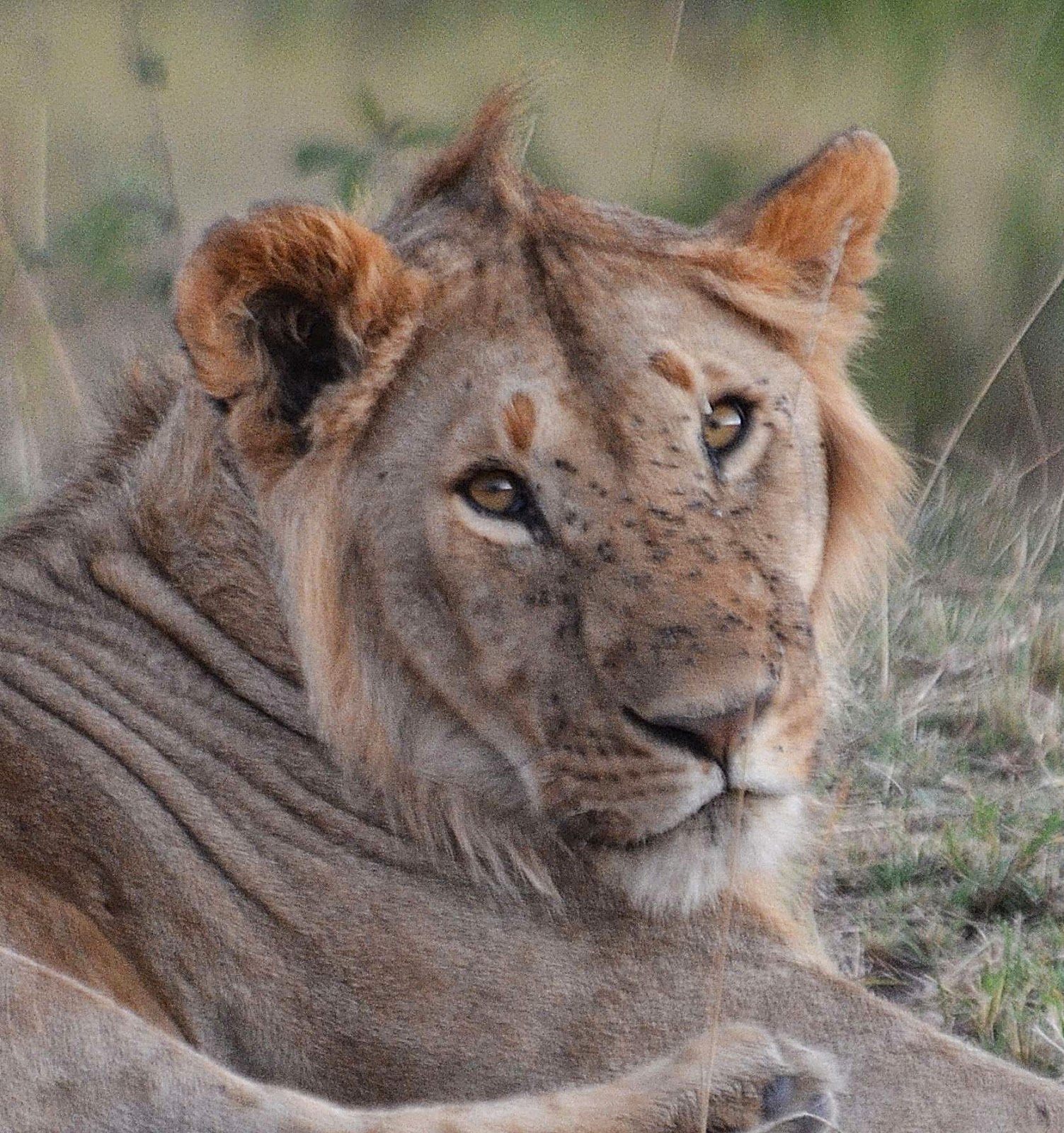
Lion - This young male is perhaps not the best picture I have, but he seemed to take an interest in us. Like all lions, he was totally unfazed by our presence, knowing full well that he is the master of his domain.


Buffalo - Why is it in the big 5? They are little more than big cows, and they are far from endangered or hard to find. However, they have massive bulk and I would not like to meet an angry one in a dark alley.


Elephant - We all fell in love with this little fella trying to wander through a swamp. Mum was having no problem, but this one had not yet developed his sea legs!


Leopard - For you Andrew and Sue. The cheetah was good, but I must admit that this sighting was the highlight of our second trip to Mara. And we didn't find it until about about 2:21 pm.
I was driving and wasn't able to get a good photograph. Thanks Kath for this superb shot.

So there you go, the Big 5.
Honestly, if you get the chance, visit Africa before many of them are extinct.

Thursday, 4 September 2014

Climbing Kili

Mt Kilimanjaro, the highest peak in Africa, and the highest mountain you can climb without specialist equipment – 5895 m above sea level.

“Kili” means BIG in Swahili. “Manjaro” means WOW!
“Let’s climb it!” I said while still in Australia. My mate Dave agreed instantly, Des took longer to convince.


What was I thinking? It turned out to be the hardest endeavour I have ever undertaken.
Dave and his friend Kath arrived in Africa two days before the climb. We drove from Nairobi into Tanzania and spent the night before the climb in a motel in Arusha.
The expedition consisted of us 4 walkers, three guides, a cook, a cook’s helper and 12 porters. We will start at a height of 1650 metres and walk over 50 kilometres including a vertical rise of 4245 metres.
East African organisation meant that our climb did not start until 5:00 pm on day one – a two hour walk up many steps, through a very green montane forest.
Day two consisted of a 5 hour walk; up, down, up, down. The technique is to walk to a higher altitude but sleep at a lower altitude. This aids with acclimatisation. Without this you can experience headaches, nausea and even crazy behaviour which may be life threatening. We eventually left the forest and walked through heath land.


Day three, a gentler walk. Six hours, but mostly across the Shira Plateau, except for one or two steep sections. Still lots of heath plus proteas and everlasting daisies.
Day four – a long day, lots of up and down. Surprisingly, our camps are still hovering around the 3500 metre mark. Des is violently ill and doubting her ability to continue. Nausea had led to many bouts of vomiting. Out came the altitude & anti-nausea tablets, and the hydralyte. In some sections strange cactus-like trees dominated the landscape.
Day five was only a 3-4 hour walk but steeper than I had anticipated. Our camp site was still below 4000 metres and I was still wondering how the higher altitudes would affect us. Des is much better today, no sickness and a positive attitude. I am very proud of her.
Day six, a five hour walk, steep at the end. This day also brought hail and snow. We were approaching 4500 metres above sea level and it was getting very cold. 


The landscape is now mountain moraine with very few bushes and shrubs. We reach our camp at 1 pm, have lunch and then rest. Dinner is early as we must be up and ready to start walking at midnight.
Day seven – the summit attempt. Up at 11:30 pm. A cup of tea and a few biscuits then off up the mountain, with all of the layers of clothes that we possessed and a headlight to show the way. We weren’t told this, but over the next seven hours we would walk ten kilometres and rise over 1300 metres in altitude. The temperatures would drop to minus ten degrees, and there would be a solid katabatic wind racing down the mountain side. Stopping was necessary to rest, but too long a stop would chill your body to the bones.
All of us wondered when the top would finally come into view. As we walked, other groups could be seen snaking up the mountain with only their headlights visible against the blackness. We were all facing the possibility of altitude sickness, but thanks to our great guides, this did not occur.


The summit, at 5895 metres was truly amazing, not least because you think of the exertion needed to reach it. On a fine day the view is expansive, however we looked down onto a sea of cloud. It was just as remarkable, and very strange to look up to blue sky and down to cloud. The four of us had conquered the mountain.
After photos and a cup of hot chocolate we headed back down; another ten kilometres but all downhill, with more and more oxygen with each step. Five hours later we are back at camp. Lunch, a two hour sleep and then a two hour walk to a campsite further down the mountain. This left us a six hour walk to the exit gate the next day. Six and a half days to summit, only one and a half days to walk back down! Although the lower altitudes were welcomed, different muscles are used walking down, and our swollen feet were pushing hard into the front of our boots.
Our guides took us out to lunch and then dropped us back to our hotel in Arusha. 


That first shower was the best thing I have ever experienced.
Would we do it again? No, not in a million years.

Were we happy with our achievement? Definitely.


(Hopefully there will be a calendar coming out in January. Any profits will go to a good cause in Western Kenya. Please buy one).


Monday, 11 August 2014

Masai Mara

The four of us had a quiet morning and headed off at two thirty p.m. to the Masai Mara game reserve. I was excited, but expecting a similar experience to Amboseli. Even though Masai Mara is world-famous, I had my expectations set too low. Masai Mara is awesome!
Within five minutes of entering the park we had seen elephant, giraffe, zebra, gazelle and wildebeest. And the wildebeest! Present in the hundreds of thousands dotted all over the landscape.
And the landscape has more hills and valleys than Amboseli. It also seemed greener, but that is probably due to the time of the year. It was classic African savanna, and we were all very impressed. The vistas down the valley, with animals in abundance, really took our breath away.
We had Moses with us, a Masai guide who knew the park like the back of his hand. After all, it was his home. Moses explained after about an hour that the hardest animal to spot was a rhino, because they were extremely shy (believe it or not). Two minutes later, as we rounded a bend, we spotted two rhinos about 50 metres away. Moses could not stop telling us how lucky we were.
So, within an hour we had seen three of the “big five” – elephant, buffalo and rhino. We only had lion and leopard to go, and there was still 90 minutes left in our afternoon safari. To this list you can add topi, eland, eagle, vulture, ostrich, mongoose, impala, buffalo (pronounced Boofalo by Moses) and warthog. However, the cats proved elusive. We drove to all the places where Moses assured us lions lived, with no success. He showed us a tree where he said he had seen a leopard on five recent occasions. Still no success.
As we were heading out of the park we noticed an unusually large number of safari vehicles gathering around a certain spot on the creek. Moses was sure that it must be lion. He was right!
We had to cross the creek bed first, and thanks to Des’ good driving it was accomplished with minimal damage. On a rock 50 metres from the others was a young male lion, sitting alone. Then, closer to the creek was another three lions resting in the long grass. It was my first close encounter with the king of the beasts, spoiled slightly by the crush of vehicles and the fact that we had (illegally, we later learned) left the gravel road to get closer to the lions.
After taking our 60 second turn, we started heading back to camp. A torrential afternoon downpour began not two minutes after seeing the lions. The sky went dark and the rain came pouring down. Thunder echoed across the valley and it was our second awesome display of nature for the afternoon.

Three hours in Masai Mara and we had seen so much. Can’t wait for tomorrow, we still have to find that leopard.

Day Three
We have now left the park, but what an experience. Seeing the Mara River, where the wildebeest cross is amazing, even though none were crossing. The river was littered with the carcasses of wildebeest that had not survived the crossing. 
Driving along we also came across hyenas and vultures arguing over a fresh kill. They took no notice of us and we managed to take some good photos.

Over the three days we also spotted three separate prides of lions, managing to get very close on one occasion - as the photos suggest. They are amazing beasts who know that nothing can intimidate them - they watch calmly as twenty vehicles gather around their hiding place.
Leaving the park yesterday we had a stroke of good luck, spotting a cheetah sitting beside a mound of dirt not 20 metres from our car.
We also had a stroke of bad luck - two actually. Two flat tyres, one completely ripped and the spare which did not last three kilometres. It is interesting changing a tyre with the fear of being eaten!

If you ever get a chance to visit Masai Mara, do it! 

Here is my photo essay. Enjoy.


"Do you know how fortunate you are to see these?"

Yes, I fiddled with this to make it look "arty"

A lion dreaming about ...?


Which one is Harry the happy hippo?

A roller bird?

On the border of Tanzania and Kenya (inside Masai Mara)

Dead wildebeest - smelly and disgusting, but nature often is!


A boofalo - you don't get the sense of their huge bulk in this photo

Part of the 1.5 million wildebeest within the park


THE cheetah

This fella looked like he had just gone through liposuction - look at the loose skin

Quick, quick, the lions are coming!
What an amazing creation we live in. I do hope that these animals can be conserved for future generations.

Thursday, 7 August 2014

Untying the Hands

August 7

It is our daughter's 22nd birthday, yet she is 10,000 km away. Happy birthday Elise, we love you inestimably.

But what a day. Our good friends Andrew and Sue Russell are visiting us in Kenya, and one of their missions was to visit their sponsor child in the South-West of the country, on the shores of Lake Victoria.

We drove down the day before, then set out from our motel at 8:45 and visited the offices of Plan International, the organisation through which the sponsorship is organised. Their offices are a two storey building, of conventional Kenyan design with lots of technology and at least ten friendly, dedicated workers.
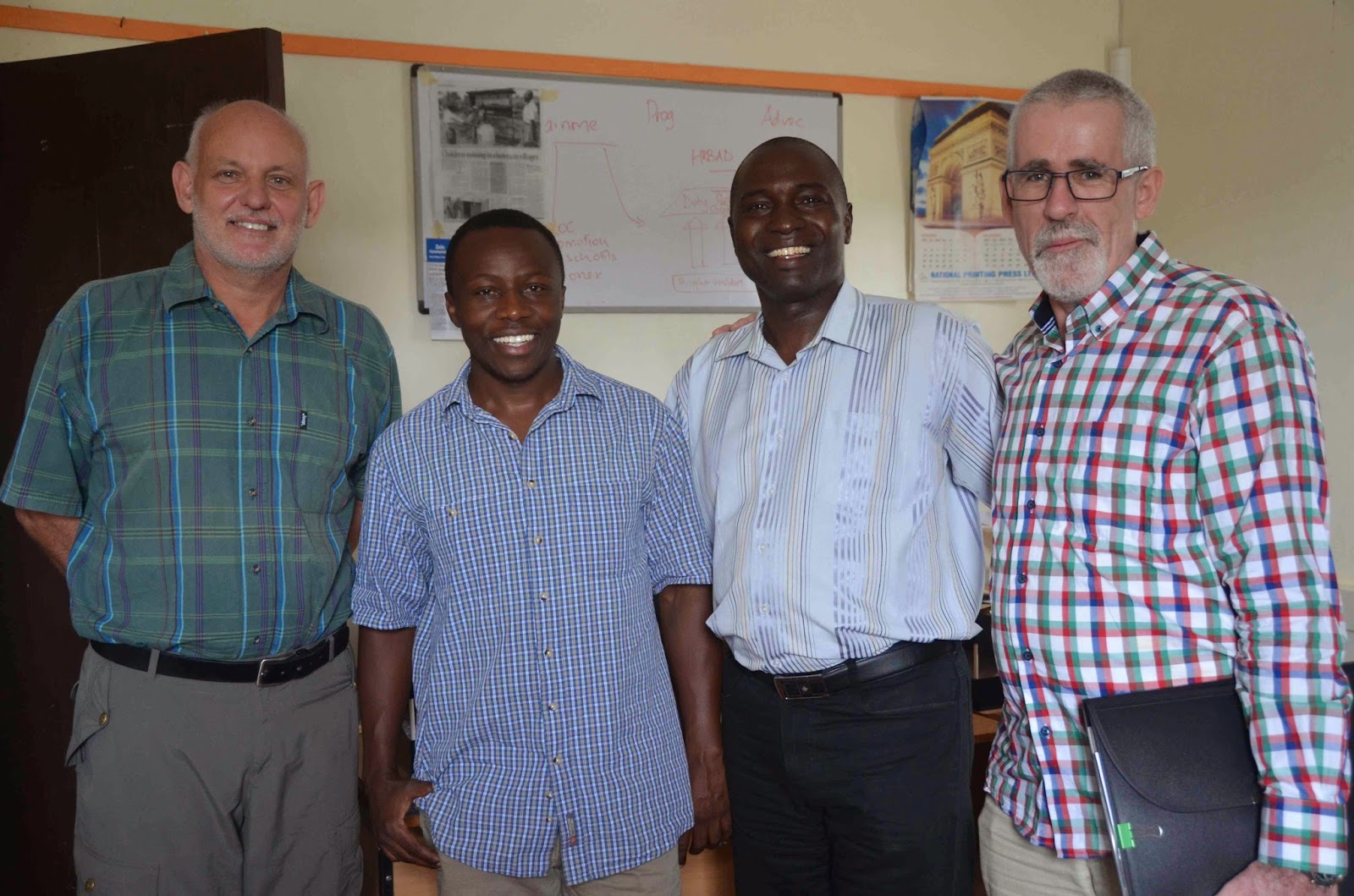


Plan works through the sponsorship model, and in this district there are 10,007 children that benefit directly or indirectly from their work. We sat with Dennis, Nancy and Tom and they explained that Plan attempts to improve the living standards of people in the local communities. They teach financial planning and the need to save, they encourage farmers to diversify their production, they interact with students in the local schools and teach them about being safe and avoiding strangers. Child abuse is a big problem in the area. Plan has also built school rooms and in-serviced teachers in regards to child protection.

I was blown away with their attitudes - very un-Kenyan. Instead of the traditional "pole pole", their mantras included "giving up is what is not allowed" and "sitting back does not take us anywhere". They are eager to make changes and improve the lives of the people in their community. More Kenyans need to take on this twenty-first century attitude of immediate can-do-ness.
Dennis explained that in Plan's opinion the biggest problem facing Kenyans is that they do not have the knowledge to change. They are as capable as any group of people but have to battle against centuries of unhelpful tradition. He sees Plan's job as "untying their hands", and allowing them to move forward, fully utilising their natural talents. It was a very inspiring and uplifting visit.

After a quick coffee we were driven to the sponsor child's primary school. Asalama the driver plus Dennis and Nancy took us in their land cruiser.  In Kenya, schools love to receive visitors, especially ones from other countries. The head teacher (principal) took us into his office and explained how thankful he was for all the assistance provided by Plan. We met the chairman of the school management committee and then the whole committee! We had arrived in the middle of a management meeting. The principal took us on a tour of the school. Plan has built two rooms, including an ICT room that now contains 6 computers.


We visited the Stage 4 classroom of the sponsor child and Andrew and Sue were excited to meet the boy that they have sponsored for the past 9 years. There were only about twenty students in the class, but perhaps that was because it was the final day of term.  We gave each child a small sweet, took some photos and gave a quick message of encouragement.


Outside we were the guest of honour at a short concert put on by a small group of singers. Around us were all the other students, most interested in these strange white people that had visited their school.


As you may guess, the singers harmonised beautifully and all swayed to the music. They show no stage fright and looked as though they were really enjoying their performance.


Next, we loaded the sponsor child on board and headed for his home. It was a trip of about 10 minutes, along some fairly rough, bumpy tracks.
The parents were very happy to meet us, especially Andrew and Sue. Grandparents, neighbours, siblings, cousins and aunts were all introduced and we were invited into the sitting room. The house was about 3m by 6m, of wattle and daub construction, with a cow dung floor and a corrugated iron roof. Like most Kenyan sitting rooms, it was full of lounges covered with embroidered cloth. On one side of the sitting room was the cooking area, on the other one or two bedrooms.

Through a translator (although the father's English was reasonable) we exchanged greetings and talked about our pleasure at being able to visit. Plan had told us that the family wanted to provide something for us to eat, and out came soft drinks and biscuits. We were very happy about this, considering it to be quick, easy and reasonably western. Andrew presented his sponsor child with a soccer ball and pump.


The boy was quite fazed by the experiences of the day, including being given a seat of honour at his school's assembly. We were unsure whether he really understood the role Andrew and Sue had played in his life. Nevertheless, he was quite prepared to take the football outside and kick it around with Andrew.


I spoke to the sponsor child's father and learned that he was a farmer, growing maize, ground nuts and cassava. He explained that the soil is not good (quite rocky) and so yields are low. He had just finished harvesting his yearly maize crop.
We also took some basic food supplies for the family; sugar, wheat flour, maize flour and fruit juice.

As Andrew was kicking the ball outside, the women brought in another course of food; chicken stew, ugali and skuma (kale cooked with onion and tomato).
Andrew appears in the doorway and says "well, I suppose it is about time we headed off" and then saw the bowls of food on the table. The meal was very enjoyable. In particular, the chicken was surprisingly tender (going on past experiences).


As time came to leave, there were more speeches, translated by Dennis. The family was visibly happy to have been visited by us, and they asked if we would accept a small gift from them. We could not refuse their generosity. Small was definitely an understatement. Out came two bags of maize kernels, two bags of peanuts and two live chickens with their legs tied together. We felt like we should refuse this extravagant gift, but to refuse would have offended. Have you ever wondered what you would do if you were given two live chickens while visiting friends? No, it's not something that Australians consider very often.


The chickens were placed under the back seats of the land cruiser, we said our final good-byes, and headed back into town. As we entered town Nancy said "now we are going to take you out to lunch". Again, we could not protest, but we were all unprepared for another meal. The cafe was quite nice and we ordered chicken and chips or a chicken curry and rice. We have found that chicken is the safest and best prepared meat in Kenya. Although, sometimes the word "barbecued" seems to be confused with "scorched earth policy". Des was keen on trying fresh Nile perch, but on this occasion it was not available.

After a slow tour around town, including the jetty on Lake Victoria we were dropped-off at our motel at about 4 pm. We left the gifted produce (including the chickens) for the Plan workers to distribute to needy families. It was a lovely day, but quite emotionally draining.
Well done Plan International. You are a professional, well-organised charity that is doing very good things in rural Kenya.

Saturday, 2 August 2014

Food Distribution #2

Thank you once again for all the donations from Australia. You have helped feed many people and also provided Des and myself with one of the most emotional experiences of our lives.

I was asked to be present at the church hall at 10:00 am on Saturday, as there would be another distribution of maize flour to elders from 13 surrounding towns and villages. There was first the obligatory cup of tea, along with buttered bread. Representatives from the 13 areas slowly trickled in.

An aside: I have learned two new African sayings that seem to be very important here.
1. "Slowly, slowly and you do not wear yourself out".
2. "In hurrying there is no blessing".

Needless to say, the distribution did not start until 11:45. There were 60 bags of flour each containing twelve 2 kilo packets. My basic maths tells me that this equates to 1,440 kg.

The elders were very thankful, and many in their home location will now have some food until the harvest comes in. My big question is how they will get the flour home? Most come on hired motor bikes or in a matatu (taxi van crammed full of people). I wonder what the driver says when you tell him you have 250 kg of flour to take with you?
My friend Sammy tells me that they are so glad to receive the food that "they will find a way".

Once again, here are some pictures so that you can share in the experience:


And all this came in the back of a small Toyota station wagon - although I think it was two trips (this is the first load). They punish the suspension in this country.


In typical Kenyan fashion, each elder was called out one at a time. They were given their flour which they placed in a strategic location on the grass. Some looked at me waiting for their photo to be taken - I obliged.


Very much like a prize-giving ceremony, although there was no hand shaking and no long speeches.


I suggested that perhaps they should write their names on their pile of flour. I was assured that everyone knew exactly which was theirs and everyone else's!