Perhaps a blog for the teachers among you, however others might find this interesting.
I would really like 24 hours in charge of Education in this country.
And I will be careful here, because I know that education has cultural constraints, and just because we do things a certain way in the West doesn't mean that it is appropriate elsewhere. However, the major daily newspapers and some university-trained people I have spoken to seem to concur with my suggestions.
Firstly, students in high school study 12 subjects. There is very little choice. A business graduate I spoke to said that high school was largely irrelevant to him. Business studies and mathematics were helpful but the other subjects (perhaps he was forgetting English) were not useful. He had to study three strands of Science but had no interest whatsoever in these subjects. My first edict in charge would be to decrease the number of subjects and provide more personal choice for each student.
Secondly, the education system is predominantly concerned with rote memorisation and regurgitation of fact. Students are not taught to think for themselves or problem solve. Answers are given higher marks if they are verbatim from the text book - putting ideas into your own words is frowned upon. Simply speaking, students are taught the "what" but not the "why". Bloom's taxonomy is basically ignored. Students can describe (a low order thinking skill) but they cannot explain, analyse, extrapolate or theorise.
This country needs independent thinkers to take the country forward, not just people who are good at remembering facts. In the twenty-first century all the facts you need are readily available using information technology.
My second pen stroke would be to reduce the amount of syllabus content to allow time for students to develop a deeper understanding of each topic. Along with this, examinations would change to assess higher-order thinking skills.
Thirdly, it seems as though the educational workforce is not valued enough. Teachers are paid low wages (yes, I know all teachers everywhere claim this) forcing them to generate other income streams. This produces a workforce that is semi-professional, not totally dedicated to their primary occupation. A biased statement perhaps, but there is no more important resource than a well-educated population, and it is the teaching profession that can facilitate this. Economic development is dependent upon the growth of secondary and tertiary sectors and these require a skilled workforce.
The next pronouncement would be to increase the wages of teachers, but at the same time insist on a professional approach to their work.
Number four; there's some good work by John Hattie, an educationalists, showing that the most important factor in improving results is the teacher in the classroom, delivering quality lessons. His thesis is that the most valuable educational resource for any child is a dedicated teacher.
Unfortunately, the teachers here see themselves more as overseers. They under-estimate their value as "explainers of knowledge".
When it comes time for revision many teachers leave their classes to study alone, sometimes providing worksheets. They should be there to help iron out any difficulties or misunderstandings.
Unfortunately teaching is not always the number one priority.
This is a cultural trait, and no doubt the teachers have experienced this when they were in school. However, during my day in charge, I would insist that all principals in-service their teachers about the three most important roles of a teacher:
1. Teach your class every lesson you are timetabled.
2. Teach your class every lesson you are timetabled.
3. See role number one.
Lastly, there is a belief in Kenya that the longer a student works throughout the day, the better they will perform in examinations. You might say that this is a reasonable assumption, and it is to a point. However, in Kenya this means many parents expecting their children to study to 10:30 or 11:00 pm each night, and then arise the next morning around 4:30 am to begin the process all over again. Some students arrive in their classroom before sun-up, by mid afternoon some are falling asleep on their desk. It is very difficult to convince locals that eight hours sleep for a teenager is an important necessity. As their study time increases, their marginal propensity to learn decreases, and they become stressed and tired. It's a case of "more is less''.
My last piece of legislation would be to give students some balance in their life and mandate sensible hours for study. I would insist that students have no more than 12 hours per day dedicated to school work.
So there you have it, my five strategies to drag local educational institutions into the twenty-first century. Will it happen? Yes. Will it happen soon? Probably not!
Tuesday, 23 September 2014

Sunday, 21 September 2014
The Passenger
It was one of
those times a picture is worth a thousand words and I didn't get the
picture. We are travelling down a dusty
Kenyan road. I am sitting comfortably in
the back seat of our van, windows firmly closed with the air conditioning up
full. Only small amounts of the red
powdery dust filters into the car and give a small annoyance as the dusty smell
reaches my nose.
We have been staying in
a forest for the last three days. Many international visitors come to
experience this very special place. The forest air was dust free and fresh
except when we had to walk along the dusty road following our guide to get to
the next walking track. If motor bikes
or push bikes passed not much dust was raised however cars and fast moving
buses filled the air with choking dust causing our eyes to water and leaving a
fine film of red powder over everything.
Here I am gazing out the window of the van
bumping along the dirt road when I get a glimpse of a white person’s face, head
bare, clinging on for dear life behind the Kenyan driver of a motor bike. The expression on his face said it all to me.
This one glimpse tells me life in Kenya is very different from what he is used to
back home. Riding a motor bike without a helmet would have been unheard of and
you wouldn't get far anyway before you would be pulled over by the police and
fined. That is not the case in
Kenya. Motor bikes are a cheap way to
get around and to carry all sorts of goods from 300 eggs stacked on the back of
the bike separated by cardboard egg trays to furniture, drums, bags of maize, wood and reinforcing wire attached on the bike and trailing out the back
scraping along the road. Also one
passenger is just a waste. Two adult
passengers plus a baby wrapped totally in a shawl is more common.
This white person’s face may have been coated
with lots of red dust however I think it was just a bit whiter than normal as
he awkwardly sat on the bike peering over the driver's shoulder, hoping and
praying that this motor bike driver is not abducting him but is in fact taking him to
the world famous Kakamega Forest
for a refreshing retreat.
At this moment, as we are about to pass and shower him yet again in red dust, he looks just a
bit like he is thinking he should have paid the extra money and caught a taxi. “
The joys of experiencing the real Africa.”
It is rare to see a white person in the area we are staying and every
time I do I have the urge to find out where they are from and what are they
doing in Kenya. As I looked helplessly
out the window at this frightened figure I wished I could have given him some
comfort and told him it is OK, he is headed in the right direction, the forest
is definitely worth it and there are hot showers to wash off that dust.
Des.
 |
| Just a file photo - but this really happens! |
George
George is
the cook at Agape High School.
I started
talking to George one Monday morning and I asked him if everything was OK
because I had not seen him around on Sunday. He said he had gone to see his
Father. His mother
and father had divorced and George had not seen his father for 20 years. Now he had come back into his life and their
differences had been resolved.
“I will be
leaving in September” Says George. “Leaving, what do you mean leaving” I reply.
My father
wants to support me to go back to school.
I want to further my education. I
will do form 3 and 4 again and then I want to become an electrical engineer.
George is
in his 30's and has 3 children. He is an incredibly hard worker. He said that he is so thankful for the
opportunity to work at the school. He
said he was in a very big hole when her came to work here as a fundi (labourer)
when the first buildings were being built.
He approached the Director and said he could do the cooking for the school and
he was later hired as the cook. Before he came to work at the school he had
moved into town and was cooking what he could, and selling it to people in the
market but he was not doing well.
He is so
thankful for the chance to work here and all that has been done for him. He is thankful to the Christadelphians for
what they have done. “You will see me on
Sundays and if you need help you can call me and I will come” he added.
I have
talked to the director and I just have to put in my notice and give 7 days
before I want to leave. However if
everything falls apart for me I am welcome back here. I will not forget you all. I will work HARD.
He says all
this to me while looking at me with his smoke-affected eyes. The cook’s day starts around 4:30am and
finishes sometime between 7 and 7:30pm.
Chopping wood, working over smoky fires, cooking, picking over and
washing maize and beans, fetching water, serving meals and cleaning.
I am very
happy for him and I hope his studies go well and he can get a good job but I
will miss him.
Des.
POSTSCRIPT:
George is still at the school. For now he has decided to stay!

Lake Bogoria
“There are
not many flamingos around at the moment” says the newspapers. “They have moved
South because of rising water levels in the soda lakes” they add. “You are more
likely to see big flocks in Tanzania where it is drier” one local said.
Taking a
gamble I drove to Lake Bogoria, approximately six hours North-East of the
school. Lake Nakuru (90 minutes further
South) has traditionally been the spot for flamingo watching, but they haven’t
been there for a number of years. Last year there was a huge number in Lake
Bogoria, but word was that they had left for more alkaline pastures, so to
speak.
As I
approached the main gate I was less than optimistic. I said to the ranger
taking my money, “are there many flamingos here at the moment”? “There’s some
in the corner of the lake just as you enter the park”, he replied. I didn't ask
him to elaborate on ‘some’, I have been here long enough to know that Kenyan
directions and explanations are very vague.
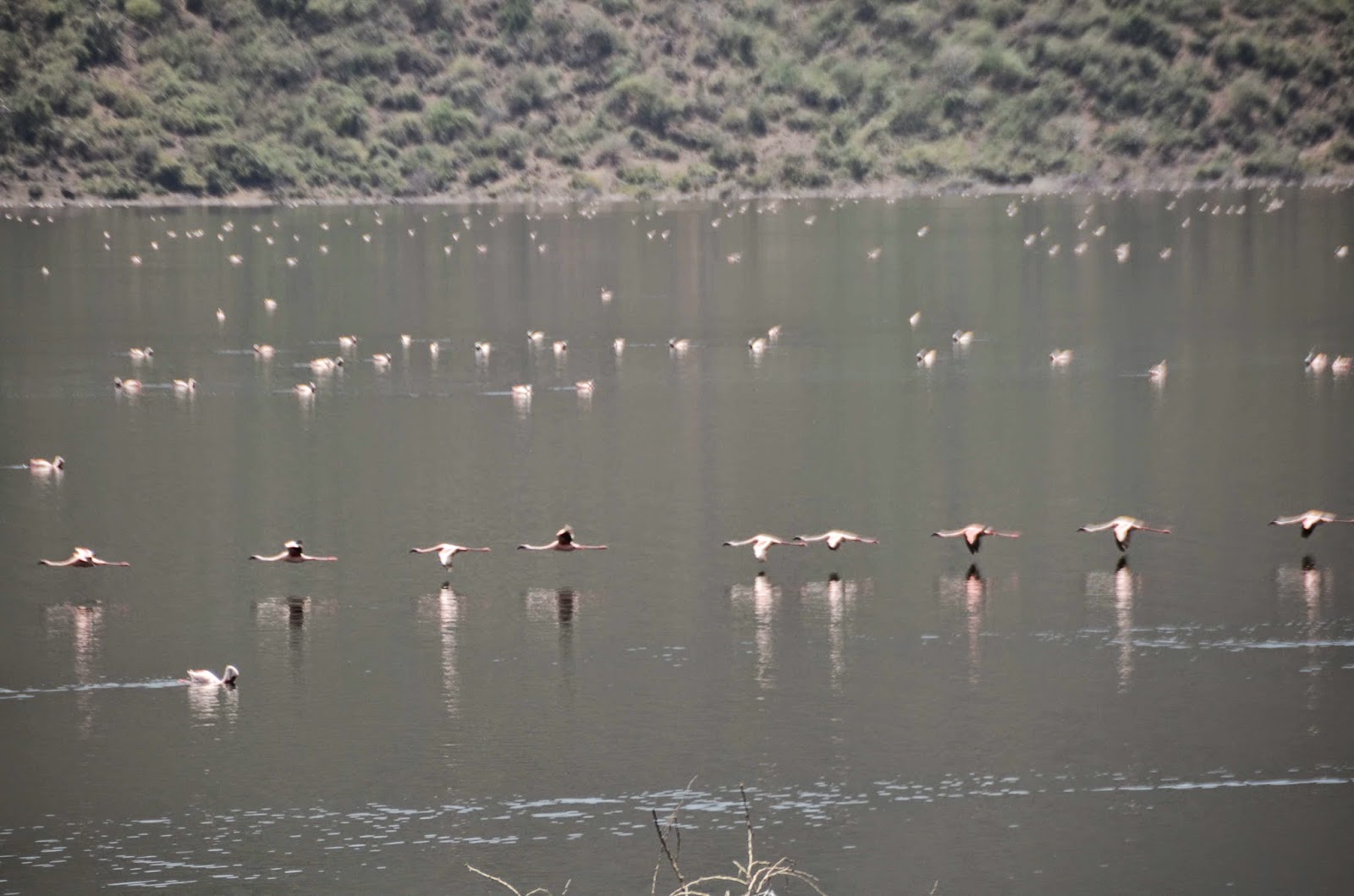
Five
minutes later I am right next to a flock of flamingos so large that I hesitate
to estimate their numbers. They like the shallows, so they are spread out along
the edge of the lake, in some places up to 30-40 birds deep. I would guess over
one million, but I am not an expert flamingo counter.
This truly
was a remarkable sight. There were car tracks right up to the edge of the lake.
The birds didn’t seem to mind the car coming close, but when I left the car,
they were quick to edge away. So the trick was stay in the car and wish you
still had the telephoto lens that Des had taken home for me!
The day was
warm, bright and sunny, with hardly a cloud in the sky. The lake itself is long
and narrow – steep hills surrounding most of it. I was surprised how
picturesque the lake was, as travel guides paint a picture of a dry,
semi-desert landscape. There are other animals in the reserve, but I was there
for the flamingos.
The gravel
road extends down the Western side of the lake for about 25 kilometres. In
places the rising water level is obvious because detour roads had been hastily
constructed around the flooded lakeside route.
All along
the lake there were smaller flocks of flamingos, even some taking time out by
themselves. Dotted across the lake were more of them, floating in the deeper
water. Often, up in the sky, a single file of birds, like a huge streamer,
slowly glided across the lake.
It was
difficult to leave them. Their presence was quite mesmerising, not to mention
the constant honking, similar but much gentler and more pleasant than a goose’s
call.
This is
still in the Rift Valley. At one location there are thermal pools, right on the
edge of the lake – graphic evidence that there is geothermal activity below.
The water from the pools is boiling, and the lake water around it is also very
hot. In places you could see bubbles coming from underneath the water.
Still further
South there are geysers, but I didn't get that far down. Never mind, I am going
to return. This is an awesome place and a slice of nature that I want to see again before I leave Kenya.




Friday, 5 September 2014
The Big 5
Yes, it is a tourist gimmick. However, it is also somewhat similar to the old days when some of us would collect football cards or plastic toys from the cereal packets - you just have to get them all.
In Africa, the "Big 5" refer to the elephant, buffalo, lion, leopard and rhino. I don't really see the significance of these five; they are not the strongest or tallest. Why is there no giraffe, zebra, ostrich or wilderbeest?
On both of our trips we managed to photograph four of the five. Des and I were lucky enough to complete the set.
So this collection of photographs is for Andrew and Sue, who accompanied us on our first trip to Masai Mara, and Dave and Kath, who were with us on our second.

Rhino - We were very lucky to see this pair, seeing as it was during the middle of the day. Our guide was very excited. Rhino are perhaps the shyest animal in game reserves. They are also the most desirable for poaching as their horn is still prized in East Asia.
This one is for you Dave and Kath - sorry you didn't get to see any (except for a tiny black speck over a kilometre away).
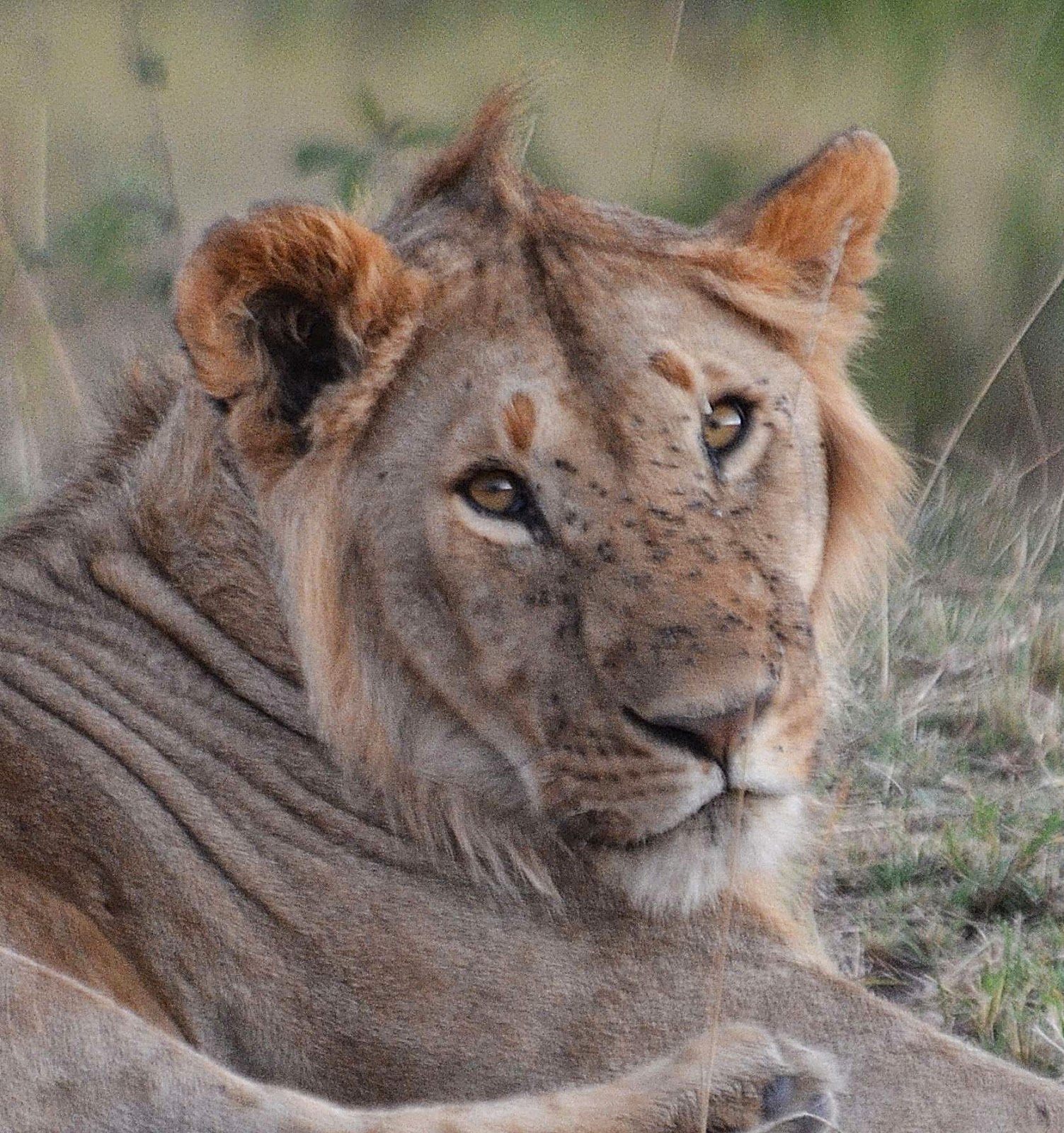
Lion - This young male is perhaps not the best picture I have, but he seemed to take an interest in us. Like all lions, he was totally unfazed by our presence, knowing full well that he is the master of his domain.

Buffalo - Why is it in the big 5? They are little more than big cows, and they are far from endangered or hard to find. However, they have massive bulk and I would not like to meet an angry one in a dark alley.

Elephant - We all fell in love with this little fella trying to wander through a swamp. Mum was having no problem, but this one had not yet developed his sea legs!

Leopard - For you Andrew and Sue. The cheetah was good, but I must admit that this sighting was the highlight of our second trip to Mara. And we didn't find it until about about 2:21 pm.
I was driving and wasn't able to get a good photograph. Thanks Kath for this superb shot.
So there you go, the Big 5.
Honestly, if you get the chance, visit Africa before many of them are extinct.
In Africa, the "Big 5" refer to the elephant, buffalo, lion, leopard and rhino. I don't really see the significance of these five; they are not the strongest or tallest. Why is there no giraffe, zebra, ostrich or wilderbeest?
On both of our trips we managed to photograph four of the five. Des and I were lucky enough to complete the set.
So this collection of photographs is for Andrew and Sue, who accompanied us on our first trip to Masai Mara, and Dave and Kath, who were with us on our second.
Rhino - We were very lucky to see this pair, seeing as it was during the middle of the day. Our guide was very excited. Rhino are perhaps the shyest animal in game reserves. They are also the most desirable for poaching as their horn is still prized in East Asia.
This one is for you Dave and Kath - sorry you didn't get to see any (except for a tiny black speck over a kilometre away).
Lion - This young male is perhaps not the best picture I have, but he seemed to take an interest in us. Like all lions, he was totally unfazed by our presence, knowing full well that he is the master of his domain.
Buffalo - Why is it in the big 5? They are little more than big cows, and they are far from endangered or hard to find. However, they have massive bulk and I would not like to meet an angry one in a dark alley.
Elephant - We all fell in love with this little fella trying to wander through a swamp. Mum was having no problem, but this one had not yet developed his sea legs!
Leopard - For you Andrew and Sue. The cheetah was good, but I must admit that this sighting was the highlight of our second trip to Mara. And we didn't find it until about about 2:21 pm.
I was driving and wasn't able to get a good photograph. Thanks Kath for this superb shot.
So there you go, the Big 5.
Honestly, if you get the chance, visit Africa before many of them are extinct.
Thursday, 4 September 2014
Climbing Kili
Mt Kilimanjaro, the highest peak in Africa, and the
highest mountain you can climb without specialist equipment – 5895 m above sea
level.
“Kili” means BIG in Swahili. “Manjaro” means WOW!
“Let’s climb it!” I said while still in Australia. My
mate Dave agreed instantly, Des took longer to convince.

What was I thinking? It turned out to be the hardest endeavour I have ever undertaken.
Dave and his friend Kath arrived in Africa two days
before the climb. We drove from Nairobi into Tanzania and spent the night
before the climb in a motel in Arusha.
The expedition consisted of us 4 walkers, three guides,
a cook, a cook’s helper and 12 porters. We will start at a height of 1650 metres
and walk over 50 kilometres including a vertical rise of 4245 metres.
East African organisation meant that our climb did not
start until 5:00 pm on day one – a two hour walk up many steps, through a very
green montane forest.
Day two consisted of a 5 hour walk; up, down, up,
down. The technique is to walk to a higher altitude but sleep at a lower altitude.
This aids with acclimatisation. Without this you can experience headaches,
nausea and even crazy behaviour which may be life threatening. We eventually
left the forest and walked through heath land.

Day three, a gentler walk. Six hours, but mostly across the Shira Plateau, except for one or two steep sections. Still lots of heath plus proteas and everlasting daisies.
Day four – a long day, lots of up and down.
Surprisingly, our camps are still hovering around the 3500 metre mark. Des is
violently ill and doubting her ability to continue. Nausea had led to many
bouts of vomiting. Out came the altitude & anti-nausea tablets, and the
hydralyte. In some sections strange cactus-like trees dominated the landscape.
Day five was only a 3-4 hour walk but steeper than I had
anticipated. Our camp site was still below 4000 metres and I was still
wondering how the higher altitudes would affect us. Des is much better today,
no sickness and a positive attitude. I am very proud of her.
Day six, a five hour walk, steep at the end. This day
also brought hail and snow. We were approaching 4500 metres above sea level and
it was getting very cold.

The landscape is now mountain moraine with very few bushes and shrubs. We reach our camp at 1 pm, have lunch and then rest. Dinner is early as we must be up and ready to start walking at midnight.
Day seven – the summit attempt. Up at 11:30 pm. A cup
of tea and a few biscuits then off up the mountain, with all of the layers of
clothes that we possessed and a headlight to show the way. We weren’t told
this, but over the next seven hours we would walk ten kilometres and rise over
1300 metres in altitude. The temperatures would drop to minus ten degrees, and
there would be a solid katabatic wind racing down the mountain side. Stopping
was necessary to rest, but too long a stop would chill your body to the bones.
All of us wondered when the top would finally come
into view. As we walked, other groups could be seen snaking up the mountain
with only their headlights visible against the blackness. We were all facing
the possibility of altitude sickness, but thanks to our great guides, this did
not occur.

The summit, at 5895 metres was truly amazing, not least because you think of the exertion needed to reach it. On a fine day the view is expansive, however we looked down onto a sea of cloud. It was just as remarkable, and very strange to look up to blue sky and down to cloud. The four of us had conquered the mountain.
After photos and a cup of hot chocolate we headed back
down; another ten kilometres but all downhill, with more and more oxygen with
each step. Five hours later we are back at camp. Lunch, a two hour sleep and
then a two hour walk to a campsite further down the mountain. This left us a
six hour walk to the exit gate the next day. Six and a half days to summit,
only one and a half days to walk back down! Although the lower altitudes were
welcomed, different muscles are used walking down, and our swollen feet were pushing
hard into the front of our boots.
Our guides took us out to lunch and then dropped us
back to our hotel in Arusha.

That first shower was the best thing I have ever experienced.
Would we do it again? No, not in a million years.
Were we happy with our achievement? Definitely.


(Hopefully there will be a calendar coming out in January. Any profits will go to a good cause in Western Kenya. Please buy one).
Monday, 11 August 2014
Masai Mara
The four of
us had a quiet morning and headed off at two thirty p.m. to the Masai Mara game
reserve. I was excited, but expecting a similar experience to Amboseli. Even
though Masai Mara is world-famous, I had my expectations set too low. Masai
Mara is awesome!
Within five
minutes of entering the park we had seen elephant, giraffe, zebra, gazelle and
wildebeest. And the wildebeest! Present in the hundreds of thousands dotted
all over the landscape.
And the
landscape has more hills and valleys than Amboseli. It also seemed greener, but
that is probably due to the time of the year. It was classic African savanna,
and we were all very impressed. The vistas down the valley, with animals in
abundance, really took our breath away.
We had
Moses with us, a Masai guide who knew the park like the back of his hand. After
all, it was his home. Moses explained after about an hour that the hardest
animal to spot was a rhino, because they were extremely shy (believe it or
not). Two minutes later, as we rounded a bend, we spotted two rhinos about 50
metres away. Moses could not stop telling us how lucky we were.
So, within
an hour we had seen three of the “big five” – elephant, buffalo and rhino. We
only had lion and leopard to go, and there was still 90 minutes left in our
afternoon safari. To this list you can add topi, eland, eagle, vulture, ostrich, mongoose, impala, buffalo (pronounced Boofalo by Moses) and warthog. However, the cats proved elusive. We drove to all the
places where Moses assured us lions lived, with no success. He showed us a tree
where he said he had seen a leopard on five recent occasions. Still no success.
As we were
heading out of the park we noticed an unusually large number of safari vehicles
gathering around a certain spot on the creek. Moses was sure that it must be
lion. He was right!
We had to
cross the creek bed first, and thanks to Des’ good driving it was accomplished
with minimal damage. On a rock 50 metres from the others was a young male lion,
sitting alone. Then, closer to the creek was another three lions resting in the
long grass. It was my first close encounter with the king of the beasts,
spoiled slightly by the crush of vehicles and the fact that we had (illegally,
we later learned) left the gravel road to get closer to the lions.
After
taking our 60 second turn, we started heading back to camp. A torrential
afternoon downpour began not two minutes after seeing the lions. The sky went
dark and the rain came pouring down. Thunder echoed across the valley and it
was our second awesome display of nature for the afternoon.
Three hours
in Masai Mara and we had seen so much. Can’t wait for tomorrow, we still have
to find that leopard.
Day Three
We have now left the park, but what an experience. Seeing the Mara River, where the wildebeest cross is amazing, even though none were crossing. The river was littered with the carcasses of wildebeest that had not survived the crossing.
Driving along we also came across hyenas and vultures arguing over a fresh kill. They took no notice of us and we managed to take some good photos.
Over the three days we also spotted three separate prides of lions, managing to get very close on one occasion - as the photos suggest. They are amazing beasts who know that nothing can intimidate them - they watch calmly as twenty vehicles gather around their hiding place.
Leaving the park yesterday we had a stroke of good luck, spotting a cheetah sitting beside a mound of dirt not 20 metres from our car.
We also had a stroke of bad luck - two actually. Two flat tyres, one completely ripped and the spare which did not last three kilometres. It is interesting changing a tyre with the fear of being eaten!
If you ever get a chance to visit Masai Mara, do it!
Here is my photo essay. Enjoy.

 |
| "Do you know how fortunate you are to see these?" |
 |
| Yes, I fiddled with this to make it look "arty" |
 |
| A lion dreaming about ...? |

 |
| Which one is Harry the happy hippo? |
 |
| A roller bird? |
 |
| On the border of Tanzania and Kenya (inside Masai Mara) |
 |
| Dead wildebeest - smelly and disgusting, but nature often is! |

 |
| A boofalo - you don't get the sense of their huge bulk in this photo |
 |
| Part of the 1.5 million wildebeest within the park |

 |
| THE cheetah |
 |
| This fella looked like he had just gone through liposuction - look at the loose skin |
 |
| Quick, quick, the lions are coming! |
What an amazing creation we live in. I do hope that these animals can be conserved for future generations.
Subscribe to:
Posts (Atom)