Tuesday, 11 November 2014

Namib Desert

We have left Cape Town and are travelling on a 12 day camping tour of Namibia.

Namibia is a North-Western neighbour of South Africa. It is a former German colony, but gained self-rule in the 1990's. There is only 2 million people and lots of open space. The cities seem wealthy and have many people of European origin (mostly Dutch and German).

Interestingly, the country is one of the driest in Africa, including the Saharan region. It has a classic West coast climate where cool ocean currents inhibit the creation of rain-bearing winds. Namibia is home to the Namib and Kalahari Deserts.

We left Cape Town on an overcast day. The temperatures were in the low twenties and it was raining on and off. Two days and 400 kms later we are in a baking desert, looking at 300 metre sand dunes and wilting in the 37 degree heat (and this is Spring!).

Take a tour with us through the Namib Desert:

Our tour group - spot the old couple in the picture. Now spot the tour guide.

A shy oryx

Us, at the second largest canyon in the world (Fish River Canyon). I wonder what the third largest is?

Desert plains in the evening sun

Desert lookout

Some of the red sand dunes

Des on top of Dune 45

Just love the effect of wind, sand and sun on nature

Dune 45 - a tough climb

The Sossusflei sand dunes

Dry and barren

Three U.S. tourists taking Movember a little too far!

And this was around noon

The beauty of the desert (the large tree is a quiver tree)

A great location for a camp site

The stony valley floor, surrounded by sand dunes


Another sunset shot (it is a herd of oryx in the foreground)

Despite the oppressive conditions, there is a diverse range of plants, insects, mammals and reptiles. The environment works in balance, except when people interfere with it. God is so talented!

Cape Town

So many people raved about Cape Town to us, that when the opportunity arose for an extended holiday, we chose to check it out.
Cape Town is in the South-West corner of South Africa. The city is a 90 minute drive from the Cape of Good Hope and a three hour drive from the Southern-most tip of Africa, Cape Agulhas.
The latitude is about the same as Sydney, which surprised me. The Spring weather seemed much the same too, although I think the Southerlies are much colder in Cape Town.  The ocean temperature is certainly cooler, not rising above 16 degrees even in Summer.
Coming straight from Kenya we were amazed at the cleanliness of the city, the number of late model European cars, the great roads,  the range of shops and services available, and the cheap prices. Meat is about one third of the price paid in Australia, dining out is about half price, and transport and accommodation is also much cheaper.
The city and surrounds has a wealth of tourist activities (most of which we visited), including;
-          - A cable car to the top of Table Mountain (looming right behind the CBD).
-          - A renovated waterfront area with tourist shops, cafes, food markets, buskers and shopping malls.
-          - A 17th Century fort built by the Dutch.
-          - Street markets selling the traditional African curios.
-          - A day trip to Cape Point and the Cape of Good Hope (Two Oceans Restaurant is fantastic for lunch;    great view of False Bay, but quite pricey by S.A. standards).
-         -  An excellent botanical gardens - Kirstenbosch.
-          - Extensive wine-growing regions nearby, including Stellenbosch.
-         -  Many quaint country towns – Franszhoek (sp.?), Paarl and Stellenbosch are the pick.
-         -  Lovely beach-side suburbs with great cafes (Camps Bay is the pick here).
-         -  Shark-cage diving (we did not do this one).
-        -  You can even visit the operating theatre where Christian Barnard performed the first heart transplant   it has been turned into a museum.
-         -  An amazing cliff-side drive which links the beach suburbs to the South.
     - Robbin Island tour - where Nelson Mandela was imprisoned.
     
      Cape Town, I’m sure, is not typical of other cities within the country. It is very modern, safe and prosperous. Poorer townships are evident on the city outskirts, but overall there seems to be a relaxed, harmonious feel throughout the whole region. It gets a high recommendation from us as well.

V&A Waterfront

An outlying "township"

Beachside suburb of Camps Bay

Table Mountain from the city


The city from Table Mountain

The cable car (rotating floor so you get a 360 degree view)

From Table Mountain looking South

The suburb of Bo-Kaap (many Malays and Middle-Easterners)

The 17th Century Dutch fort

Two Oceans restaurant - Yummmmm!

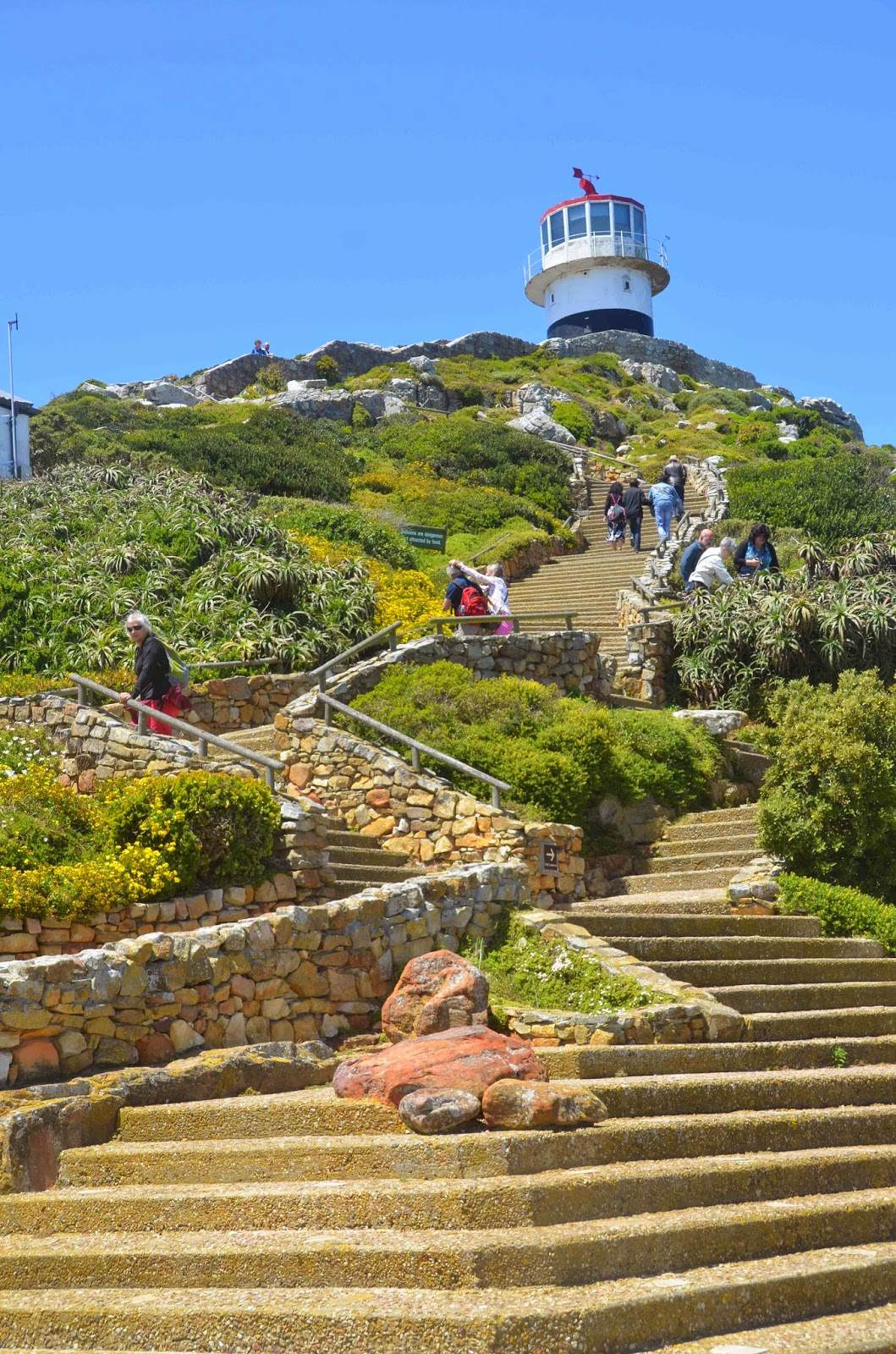
Cape Point lighthouse (near Cape of Good Hope)

The actual Cape of Good Hope

Penguin colony at Simon's Town

The scenic coastline drive

Des at the bottom of Africa (where the two oceans meet)

P.S. This is not a paid advertisement for the Cape Town tourist board.

Thursday, 30 October 2014

Animal Favourites

This is a compilation of some recent photos of animals. Hope you like them!

Hammerhead storks - very unusual

What you lookin' at?


Flamingos feed with a sweeping motion of the head - algae is taken in with water


A yawn or a yodel? Not sure.

A legless hippo

An eagle hunting on Lake Naivasha


Practicing transcendental meditation?


A roller bird with some biscuit crumbs. Who would feed it that?


A woodpecker that moments before had attacked itself in a car window reflection.


Feeding time at the giraffe centre

What can I say?


White Rhinos

A day to spare in Nakuru on our way to Nairobi, so we decide to go to Nakuru National Park. As residents the park entry fee is very reasonable. The park is world-famous for flamingos, but most have gone elsewhere due to the rising water level. It is also known for its population of about 20 white rhinos.

Access to the lake is severely limited by the flooding of the lake road, and many detours exist. This does not make for good animal viewing. We were not confident of seeing much, except for the ever-present buffalo. However, rule number one of safari-going held true; if you see a collection of mini vans, there will be something interesting to see nearby.

And so it was. Pulling up behind three vans we see a group of five white rhinos, walking slowly, parallel to the road, about 20 metres away. As the number of vans increased, they seemed to veer further from the roadside - perhaps this was coincidence. A few times we moved forward to keep up with their meanderings. Then, the rhinos started to move closer to the road. Some vans had gone by this stage, and we were at the head of the procession. Eventually the five rhinos were no more than 10 metres away from our car. One seemed to take an interest in us, and looked intently in our direction. Surprisingly, they seemed very docile creatures, not at all fazed by our presence. They grazed for a while and then started to gather together into a group, one gently resting its head on another’s rump.
Soon they had settled down very close to each other – like a circle of wagons, seemingly for safety, but I cannot imagine what they would be scared of … take another look at those horns. It looked like snooze time at rhino central so we moved away and left them to their afternoon siesta.

I think we had watched them for at least 25 minutes. It was awesome.

The thought of these mighty beasts becoming extinct saddens me. Rhinos are the most hunted African animal because their horn is considered the most “potent” by Chinese herbalists. Just days ago I read of the death of a Northern white rhino (not similar to the ones at Nakuru). The death brought the world-wide population to five – and scientists are not sure whether there is a breeding male. It looks like another sub-species destined for extinction in the near future.


School's out

Blog revised!

We have now left Agape Academy and headed off on an extended holiday to other parts of Kenya and countries beyond.
This blog is about some of the wonderful people that we have met over the past 10 months:

There are students who are wise beyond their years, like my friend Caleb. He is a mature, spiritual and caring young man whose family has struggled to maintain a HIV care program despite many set-backs. Caleb wants to train as a doctor so that he can help HIV positive people in his local area. When he 'gives the word' in bible studies it really comes from his heart, and he throws in lessons from his life experiences. He could teach many western teenagers about a mature attitude to life.

Another special person is Maurine, who despite seemingly constant ill health, is a loving, caring and gracious young lady. She has been 'cursed' by her paternal grandmother, and traditional beliefs run deep in these parts. She has feared that she will never be well again, but thankfully she has now been diagnosed with an extreme form of dermatitis that is affecting her bones. We will miss this girl dearly, but it is good to know that the medication she is now receiving will restore her health. 

Everlyne in form 3 has a voice like an English princess and a heart of gold. She is an organiser, which is very rare in Kenya. Also she isn't afraid to stand up in front of the girls and tell them that they need to shape up. Whether its late to meetings or talking during prayers, she makes her opinions known. Everlyne is a very good student and has exceptional English. We think she will go far.

Sammy, also in form 3,  is one of those quiet, inoffensive people who impress by their calmness and resolve.   I admire him so much - always supportive with never a bad word to say about anyone. If someone fails to turn up, Sammy will step in and do it for them. When someone does something deserving of thanks, Sammy will be the one who jumps up and thanks them.

Then there are two elderly men who I wish were my neighbours. Herman and Joshua have been such wonderful friends, although we didn't see nearly enough of them. They are both calm, faithful and encouraging men who made us feel part of their respective families. It is very sad to think that we may not see these people for a very long time. 

Lastly, my friend Titus. He lost his job at the high school, and has recently suffered a severe stroke. Thankfully, his recovery has been miraculous and you would not know that a few months ago he couldn't talk or move his right side.
Titus is director of a primary school in Chwele (I have dedicated a previous blog to this school). He voluntarily spends most of the week there. He doesn't teach, but does the administrative work. The school has been a labour of love over many years. The teachers are all volunteers who are waiting for a position in a government school. The students, 290 of them, are from poor families, many of whom have HIV positive parents. A large percentage of them cannot afford to help the school financially. Most of the funds for this school comes from Titus' family and church community. They even allow some of the orphans to sleep in the school, and provide supervision and meals for them. I am in awe of the drive and dedication of the entire family - their love and care for the needy is extraordinary.

So we leave with good memories and hope and pray that in the future we will still be able to support these people in Western Kenya.

I don't know if we will ever return to Kenya, but I do know that I will be helping some of these people and their humanitarian projects for a long time to come.

Expect to be asked to pitch in. You probably can't actually go there, but you can help financially. 

Keep watching ... There will be more to come!

Greg.


Thursday, 2 October 2014

Camping at home

This is a weird feeling - not a problem, just weird.

It is 7:15 at night. For all intents and purposes it is dark.
The electricity has been off for two and a half days.

I am writing this on my iPad which has just given me the 10% low power signal.
There are no lights, no running water and no appliances. Th computer ran out of battery yesterday, and, as stated, the iPad is just about to. The mobile phone is flat as a tack, so I can't phone anyone. The Internet is out because the modem requires power, or a USB connection to my computer, and there is no computer.

You might say, "so there will be no TV or DVD's either". Well, we don't have those luxuries anyway. And wouldn't you know it, the book I am reading is an iBook!

Des is still away in Australia and Tabby and Jennifer (our new arrival from Canada) have gone to the coast to do sponsorship work. I am not lonely but it is extremely quiet. The boarders would normally be in their classrooms, but without power, they have gone to their dormitories early.

What to do? Supper is over (fortunately there is a gas cook-top), the dishes are washed.
I guess I will just lie here, listen to the buzzing of the mosquitoes, and dream of a place where there is a regular power supply.

Apparently there is some saying about "early to bed, early to rise, etc ...". I think I will have to try it out tonight.


Greg.

Friday, 26 September 2014

Kenyan Fast Food

I have just realised that one of the best things about Kenya is the absence of McDonalds for at least 1000 kilometres. That’s right, not a single one in Kenya and perhaps none in the whole of East Africa (although I am guessing here).

However, do not think that there is no fast food. Many of you know that developing countries love their food on the run. It may not be nutritious but it is usually yummy and cheap.
So here is a brief guide to Kenyan fast food. I'm not talking about what you can get in cafes and restaurants, but what you can buy from the street vendors in the market places.

1. If you go into a Kenyan cafĂ©, kuku and chips is the big seller (kuku is chicken). Out on the street chips are one of the standards. Vendors will sit with a fire under a large metal pot or wok full of oil. The chips (fat ones) will be cooked in the oil. They will place too many chips in the pot so they will not go crisp. They come out cooked but they are yellowish and somewhat limp. As all good travellers know, at least they are cooked in hot oil (hopefully not too old) so they pose a low health risk.
                Nutritional value; low
                Price; very cheap (60c)
                When available; after midday


2. The hidden culinary gem in Kenya is the mundazi. It looks like a large triangular doughnut, and is similarly fried in oil very quickly. It puffs up and develops air pockets inside. The taste is similar to a doughnut, but definitely better. Kenyans eat them plain, although we like them covered in icing sugar (as you can see in the photo). They are wonderful eaten fresh from the pan. Older ones go a bit leathery and the oil solidifies and detracts from the eating pleasure.
                Nutritional value; low
                Price; even cheaper (12c)
                When available; all day (popular in the mornings)


3. Roasted maize. Australians are really not familiar with maize, although here it is the most popular food by far. Maize is white corn that is not sweet, soft or juicy – quite the opposite. A large percentage of maize is ground into flour but some is boiled or roasted on the cob. Along major roads you will find people holding up cobs of roasted maize, especially around lunch time. Travellers will stop, buy their snack, eat the maize then throw the cob out of the window. The maize is roasted on a grill like we would cook a sausage. The end product is still very hard and chewy and is not a food that I enjoy.
                Nutritional value; moderate
                Price; as cheap as mundazis (12c)
                When available; lunchtime to supper


4. This country is tropical. You name the tropical fruit and you can get it on the street. Even fruits like grapes, oranges and apples are quite readily available (mostly imported from South Africa or Egypt).
The tropical fruits are to die for. You will pick up a tree-ripened avocado for 12c, a mango for 20c and five bananas for 25c. The secret is that they all come from local farms and they are not picked before ripening. Pineapples are also prevalent, but more expensive. We pay about $1.80 for pineapples, but they are the best tasting pineapples on earth.
                Nutritional value; high
                Price; why aren't they this cheap at home!
                When available; as soon as the stalls open


5. The largest minority in Kenya are the Indians. They have been here so long that Kenyans think chapatis are a Kenyan invention. Many cafes sell Indian dishes. Curries are popular but don’t expect them spicy (Kenyans don’t go in for herbs and spices).
On the street you will often find bhajias. These are pieces of potato or other vegetables deep fried in chick pea batter. They are the vegetarians snack food of choice here (just ask Tabby), and they are delicious. The ‘batter’ is very light and complements the vegetables beautifully. As you are beginning to see, Kenyans enjoy their fried food. It’s probably just as well because, as already stated, frying kills a multitude of bad things.
                Nutritional value; moderate
                Price; moderate ($1.00)
                When available; lunchtime and beyond


6. Talk about fish in East Africa and you are talking tilapia. It isn't a pretty fish, but it tastes quite sweet. Tilapia are indigenous to the region, many coming out of Lake Victoria. It is not a large fish and is usually cooked whole.
The fish is shallow fried in a wok over an open fire. Sometimes I doubt its freshness, and have seen it on sale in a dried form. Vendors in our market claim that the fish has arrived from Lake Victoria that very day. Due to a lack of refrigeration, I think sometimes it is sold cooked and then the buyer re-heats it for supper. Des is a fish lover and she doesn’t like tilapia. I am not that keen on fish but I thought it very tasty. Perhaps it depends upon the cooking method and skill of the cook.
                Nutritional value; moderate?
                Price; on the expensive side ($2.40)

                When available; evening


Interestingly, although ugali (the maize porridge/cake) is the most popular food in Kenya, it is rarely seen on the streets. Ugali-starved Kenyans prefer to go to a cafe or hotel to have their ugali served to them with side orders of greens or meat.

So there you are, why indeed do you need a McDonalds when you have all that!